
“Why do we fall, sir? So that we can learn to pick ourselves up.”
One of my favorite movie lines, and never were words more true. In every sense of the word, it had been a long time since I had fallen. About ten years or so, as I recall. My last fall was not physical, but emotional and mental. I remember thinking there might not be a path forward and if there was, I could not be quite sure where I would land.
Of course, I was blessed in so many ways and I did find a path forward. One that led me to a better place where my soul and mind began to heal. I was not alone and never would be. I did not forget what I had learned in picking myself up, but I knew there would be times when I would need to fall again, if only as a reminder.
January 1, 2026. A new day in which to begin.
My compulsive behavior kicked in immediately. I began removing Christmas decorations and moving furniture that had made way for a Christmas tree back to its original spot. Carrying furniture down stairs is something I have done countless times, ever since I can remember. Why should that day be any different?
Nowhere in my mind did I ever once think I could fall. It never occurred to me that I should plan out such a simple task or take precautions. Turns out, that is exactly what could happen and did.
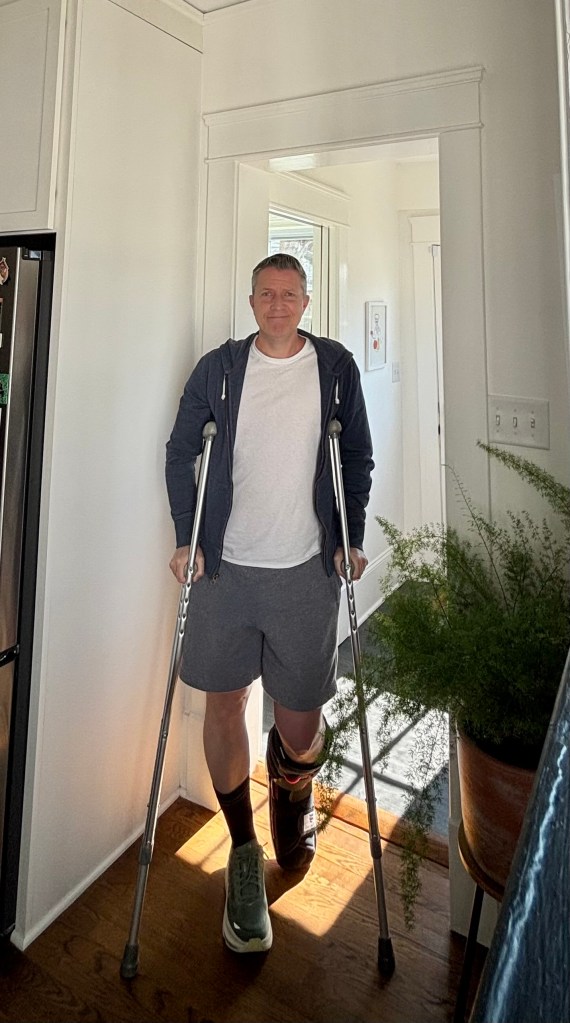
Multiple breaks in an ankle that appeared to be in the wrong place, a broken nose, and a less than cognizant state of mind earned me a ride in an ambulance, a trip to the emergency room, surgery complete with a sleeve of screws that even Frankenstein would be aghast at, and of course, a set of crutches.
I remember thinking, this is not real. I do not break bones. I heal quickly. So why am I sitting here staring at the wall with no plan for what to get into next?
Well, perhaps it was time to fall.
I cannot remember a time when I sat still for more than a few minutes. I could not even stand taking more than a month off after a thirty year career before starting my next one. Even my vacations were planned and full of activities.
The first several days, I squirmed at the thought of another minute of confinement and rest. I fell several more times as a result of my impatience and yet, even knowing the risk of trying to do instead of just being, I could not help myself day in and day out.
Fear set in as I was left alone with my thoughts. Too much time to think had always been one of my greatest fears. I was never quite ready to face all that I had suppressed. I could not seem to find enough distraction from the things I never wished to think about again.
And then things began to shift.
I got tired of fighting myself. I reflected on how minor this was compared to what others deal with each day. I started to become more attuned to things I often did not notice or had taken for granted.
Each day, I experienced things a little differently.
Five minutes without pain became an achievement marked with thankfulness. The opportunity to shower became an invitation to take a few extra minutes just to feel the sensation of water hitting my skin. I found myself tasting each sip of coffee and appreciating the flavor.
I sat by the window simply to feel the sun or watched the snow come down without worrying about how to coordinate services during the event. I realized that each email or call was not a race to crisis, but something that could be handled without stress or anxiety in due time.
There was joy in watching my Pizza Hut pizza arrive by delivery and reminiscing over the smell that filled the house. I rewatched every episode of Star Trek the original series and saw just how ahead of its time it really was. I felt the genuine care my wife has for me in every gesture of kindness. I began to look forward to hearing the First Baptist Church bells each hour with a special song at noon.
I started to understand again.
All of these things came with a new appreciation because just like seeing the sun after days of rain, I had to fall to feel the joy of not falling. I had to slow down in order to truly feel what was around me. I had to lean into thankfulness and faith, even when things were not going according to my plan.
I often fool myself into believing that if I just reach a certain level of accomplishment, I will take the time to experience and enjoy. I will capture the moments, feel life to the fullest, and embrace the things that give us perspective and balance.
That did not happen.
Instead, I moved from one task to another, one project to the next, never slowing down for fear of what might creep in. In doing so, I prevented myself from experiencing both the good and the difficult.
I needed to fall, so I could learn how to get back up again.

 Conversations with Chris